Manager platform
 Hone
Est. 4 minutes
Hone
Est. 4 minutes
The problem
Our admin users are busy. They are also typically (especially at larger companies) attuned to the needs of the organization as a whole, not necessarily to the needs of individual learners. So far, Hone had been serving the former need well, but not the latter.
But determining the right training for a given learner is only half the battle. The other half is getting them to actually complete it! Again, since the only users we were serving were our admins and the learners themselves, the onus of following up to encourage engagement also fell squarely on our admins' shoulders. This created an unsustainable bottleneck. We needed to figure out a way to make it feasible for admins to support more learners to help both Hone and our customers scale.
The solution
Our passive research had already uncovered that admins were delegating to managers of learners fairly often for help in driving enrollment and engagement in admin-produced learning and development programming, so we knew there was an appetite for Hone to support this kind of delegation through the product.
Further, since managers were also being made aware of Hone as a development opportunity (even if those managers didn't necessarily have access to Hone classes themselves), we also identified an opportunity for managers to be more involved in determining what training would benefit their direct reports.
To leverage their (a) knowledge of our learners' development areas and (b) relationships with our learners, we decided to build an interface specifically for managers of Hone learners that would enable them to view, follow up on, and promote their direct reports' professional development through Hone.
The scope
Reducing scope for this feature was difficult because we had lots of fantastic ideas for how to engage this new type of user! Some functionality that didn't quite make the cut for this first version were:
- Allowing managers to enroll learners in admin-built programs. This has the advantage of filling programs with learners who have institutional support to dedicate the time and effort needed to complete them but doesn't solve for the need to address individual learning needs and was ultimately too complex in design and implementation to move forward with.
- Allowing managers to add direct reports missing from their platform. Although it would remove some legwork for admins, for reasons primarily relating to data safety, validation, and cleanliness in addition to level of effort, we decided to punt on this functionality.
- Allowing managers to activate Membership for their direct reports. This was potentially a major engagement lever for us for several reasons. We decided to keep the initial set of work lean to get our managers into the platform as fast as possible but we fast-followed with this functionality.
We also had to reckon with the fact that our admins might also benefit from some of this work. For example, requests from admins have come in here and there to be able to 'simply' assign a one-off learning experience to a given learner, very similar to what we were trying to accomplish with managers here.
However, our admins' bread and butter is the program, defined as a set of classes typically grouped around a given use case or set of competencies, such as level-setting with newly promoted managers. Hone programs come with robust participant tracking and reporting to help our admins move as many learners through their programs as possible. Ultimately, the lack of a more lightweight mechanism for admins simply wasn't a big enough problem to justify including here. Consequently, we omitted updates to our admin platform from our scope. The admin needs we chose not to address here were documented and fed back into the roadmap — they'd get built, just not as part of this effort.
A laser focus on our initial problem statement meant that we landed on the following set of work:
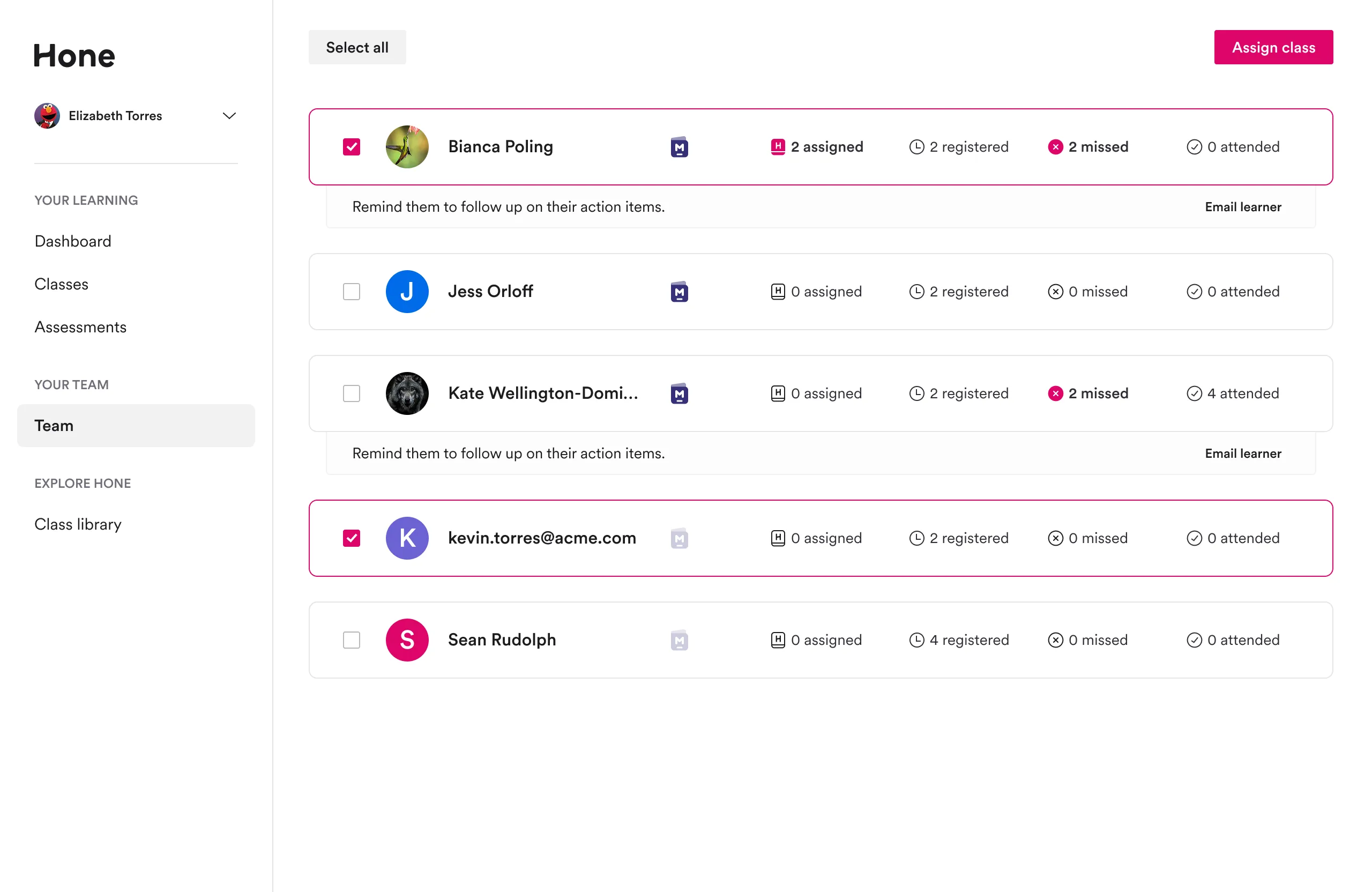
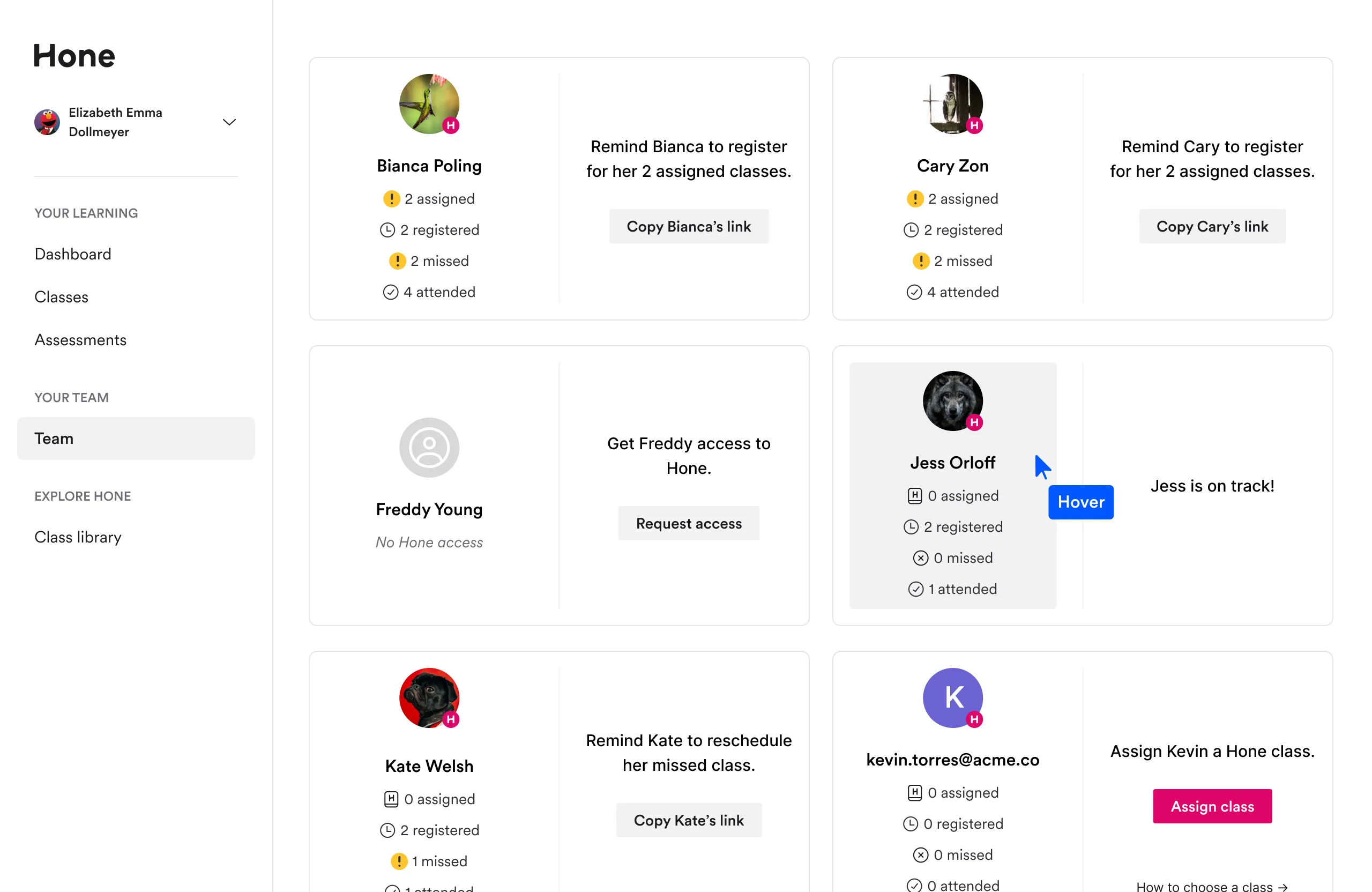
- To enable managers to view & follow up on Hone activity, we needed an interface that laid out their team's engagement with Hone, including any potential action items.
- To enable managers to promote continued development, we needed a way for them to assign learning experiences to their direct reports.
This project was phased in the same order to lower time-to-value and ensure managers had a way to check the status of the classes they had assigned once that functionality was released.
The process
Ideation: View & follow up
Since managers weren't necessarily going to be Hone users or have a lot of context on what Hone is, it was important to incorporate education into this experience. This took two forms:
- Explicit: Defining terms and concepts and orienting those concepts within the Hone experience
- Implicit: Prioritizing UI elements and information such that a manager gains an understanding of the most important concepts to pay attention to
Information that's important for managers to know overlaps in many ways with what admins look at, which opened a door for us to reuse some existing components and shorten our development timeline. However, managers differ from admins in one big glaring way: they are supporting vastly fewer learners! The tables, exports, dashboards, and data visualizations that our admins live and breathe were simply not appropriate for this new type of user.
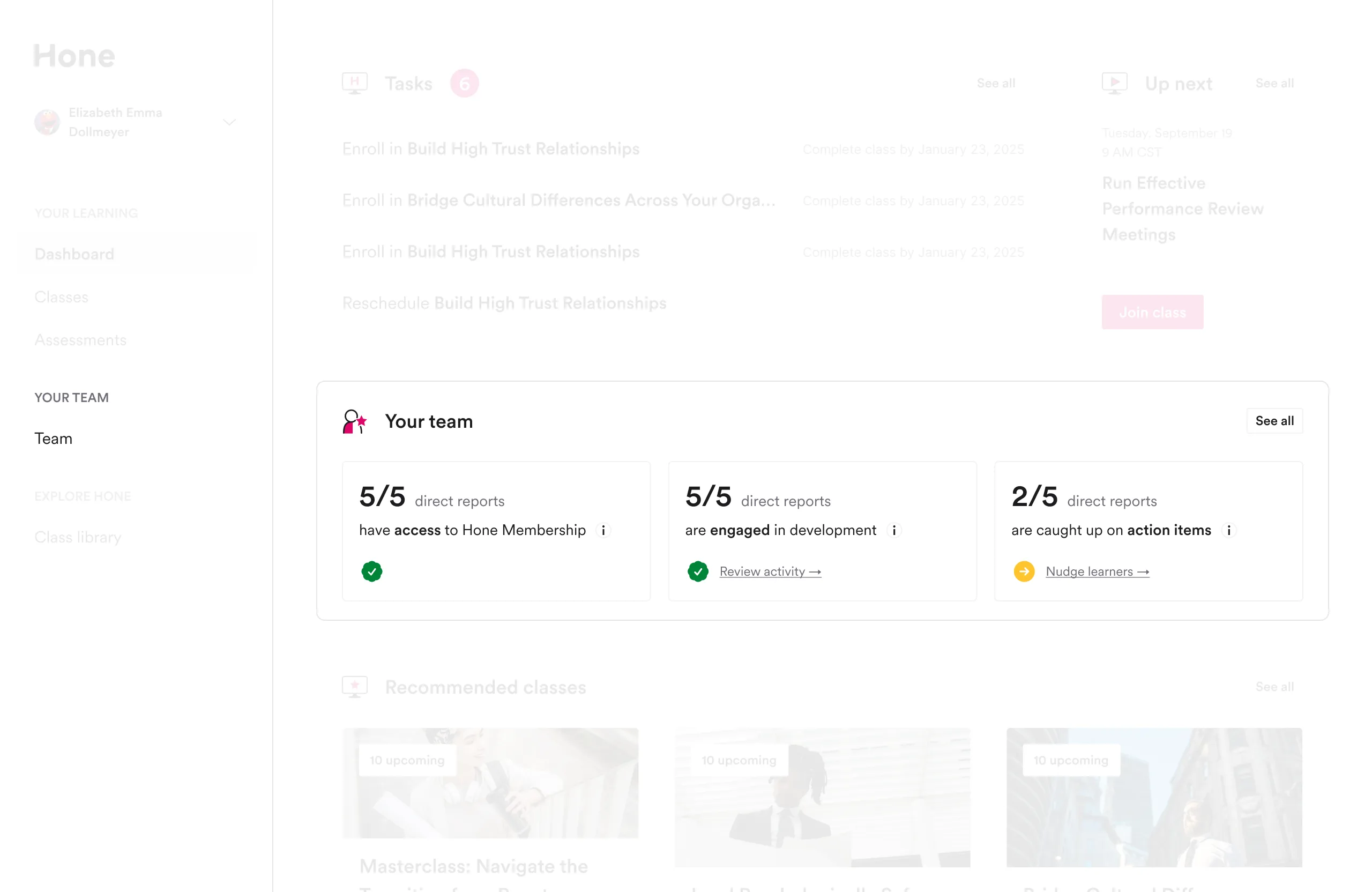
Although not every manager using the manager view would be a Hone user themselves, some would. For those managers, we had a unique opportunity to demonstrate the value of the manager view and streamline their touchpoints with us by integrating insights from their direct reports' activity into their own Hone dashboard.
Ideation: Promote continued development
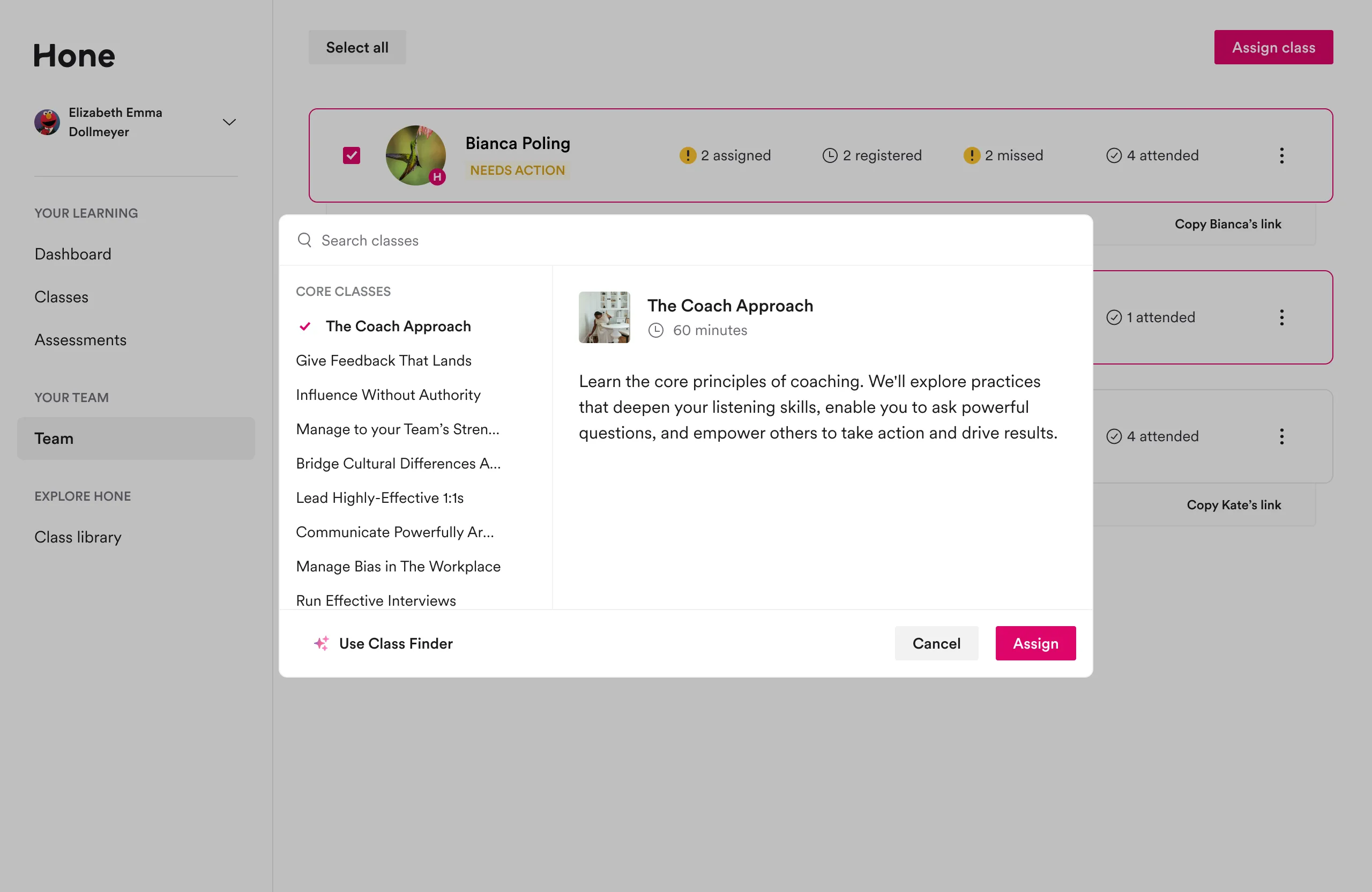
Our biggest debate around this aspect of the feature was whether we should orient class assignment within:
- the catalog context. Our class catalog is purpose-built to provide lots of context on all our learning experiences, making it easy to tell what is covered in a given session and who would benefit from it. In other words, it's an invaluable resource for a manager looking to support their direct report's development. It's visible to everyone, regardless of whether they have a license to attend classes themselves, and are easily link-able to facilitate discussion on Hone topics outside our platform. For managers who are Hone learners themselves, it also helps keep their direct reports' development top of mind.
- the manager view context. Simply put, no matter strongly the catalog view recommended itself, it did not make sense to exclude this functionality from the manager view. To make it as simple as possible for managers to do everything we want them to do, we should not make them leave the experience we've crafted for them and where they can see their actions take effect on the page.
Should we start with the class and add in the learner? Or start with the learner and add in the class?
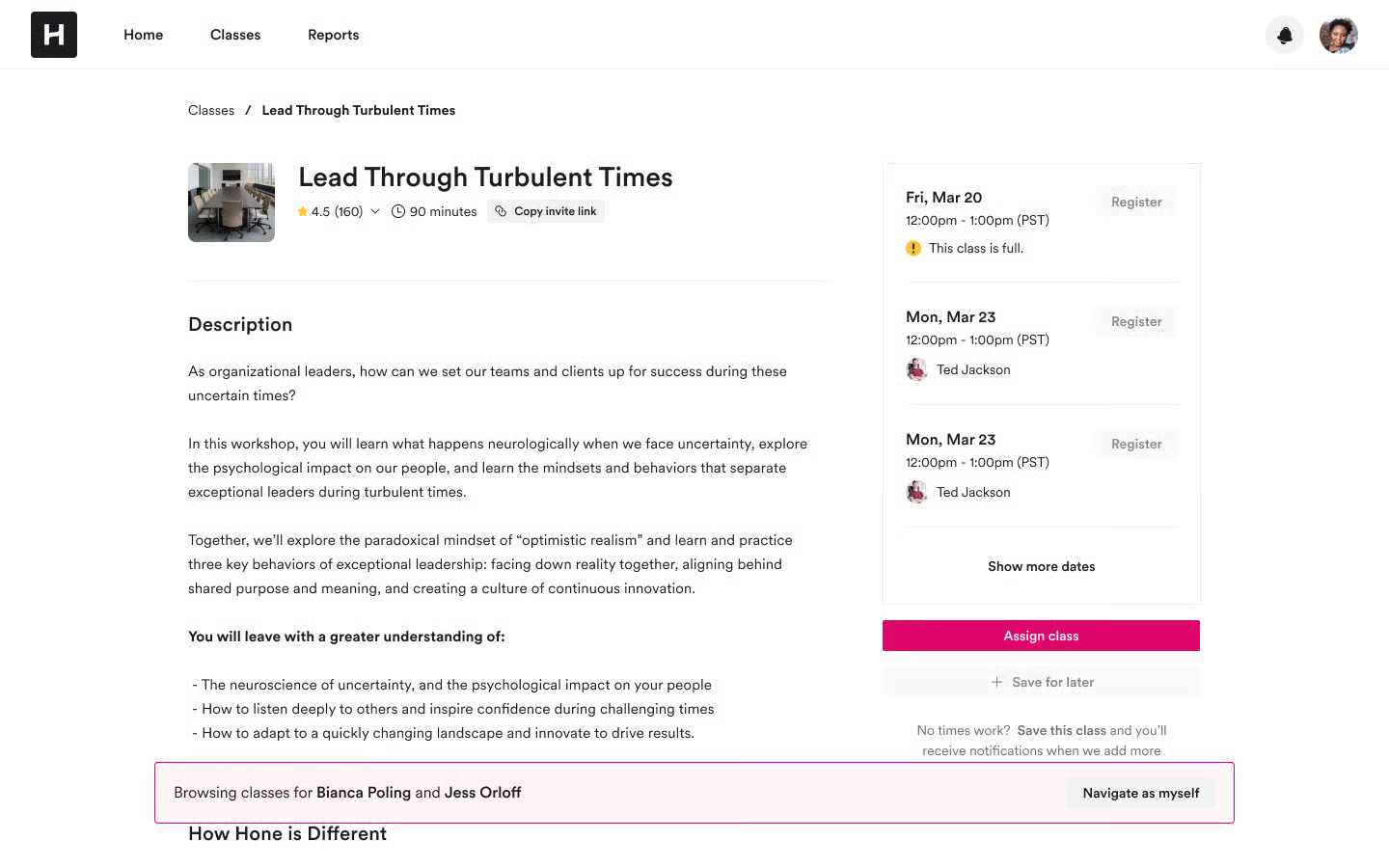
In an approach I might only take one time out of 20, we decided to include both entry points. The manager view entry point had the most appropriate context and tested well, while the catalog entry point was lightweight enough that it didn't significantly enlarge our scope, had growth potential, and set up a pattern for us to reuse when we expanded this functionality to our admins in the future.
Release
We launched to a small subset of enterprise customers first. Our CSMs collected and shared feedback from admins, who in turn passed along positive feedback from managers, validating that we had solved an important need. Admins reported immediate time savings and managers began using the dashboard without additional onboarding or documentation.
The speed of this rollout helped demonstrate how design-led iteration could deliver measurable value quickly, paving the way for further investment in the manager experience.
The aftermath
The manager platform has seen significant adoption: 1,203 unique managers visited their team dashboard in the past year, a user base that didn't exist in the product before this work.
The post-launch behavior also validated the core scoping decision. About 75% of class assignments were made to a single learner at a time, confirming that managers were using the feature to address individual development needs rather than assign classes in bulk. That distinction mattered because it meant the manager platform was doing something genuinely different from what admins were already doing, not duplicating it.
After validating the core interactions, we expanded the feature to allow managers to activate Membership for their direct reports and added an email digest so managers could stay on top of their team's activity without logging in.